Editor’s note: This article by Todi Pruteanu, VP of Product Marketing at FintechOS, was originally featured in the Future Banking Digital Scorecard 2026 report. You can download the full report here.
Romanian banks have made real progress on the capabilities the Digital Scorecard measures – digital onboarding, digital lending flows, strong mobile payments, and increasingly sophisticated in-app experiences. But as those capabilities become baseline, the next wave of differentiation will be decided less by adding features and more by industrializing outcomes: faster product evolution, better conversion, stronger product mix, and lower operational drag – while remaining compliant and auditable.
That is why AI is now at the center of every board conversation – and why so many programs still struggle to translate ambition into enterprise impact. Banking IT remains structurally fragmented: data is split across silos, applications are duplicated across business lines, origination stacks proliferate, and AI too often appears as isolated initiatives rather than a true operating model. The industry spends heavily to sustain this complexity. McKinsey-sized numbers underline the scale: $4.7 trillion in global financial services IT spend, with the majority allocated to legacy maintenance – and an estimated $780 billion modernization window. The opportunity is significant and many institutions will pursue progressive modernization without changing the core, prioritizing incremental wins that reduce risk while improving speed and economics.
The AI gap is not about model quality. It is about where AI lives. When data and workflows are fragmented, AI has no consistent substrate to act on – so impact stays local and hard to govern. The shift now underway is more fundamental: AI delivers durable value when it is embedded directly into operational platforms – where product rules, risk controls, and customer journeys are executed, measured, and audited. Put differently: the strategic question is not which AI tool should we try next but rather: “Are our operational platforms ready to carry AI as part of the bank’s infrastructure?”
Origination is the clearest proof point of this change because it concentrates customer experience, risk, fraud, compliance, and cost-to-serve into one domain. Gartner’s direction is unambiguous: origination absorbs roughly 25–30% of digital banking transformation budgets, 60% of banks plan to consolidate fragmented LOS stacks, and 40% rank origination as a #1 IT priority. In other words, if a bank wants to prove that “embedded AI” can drive enterprise outcomes – not just experimentation – origination is where it becomes visible. This also links directly to the Digital Scorecard itself. Many of the highest-value Scorecard criteria are, in practice, origination outcomes: online onboarding (retail/SME), online consumer loan and credit card origination, mortgage pre-approval and document handling, and the security and support capabilities that make these journeys trustworthy at scale. These aren’t standalone “features” – they are the surface expression of deeper operational readiness: unified data capture, consistent pricing and eligibility, governed decisioning, document intelligence, and workflow orchestration end-to-end.
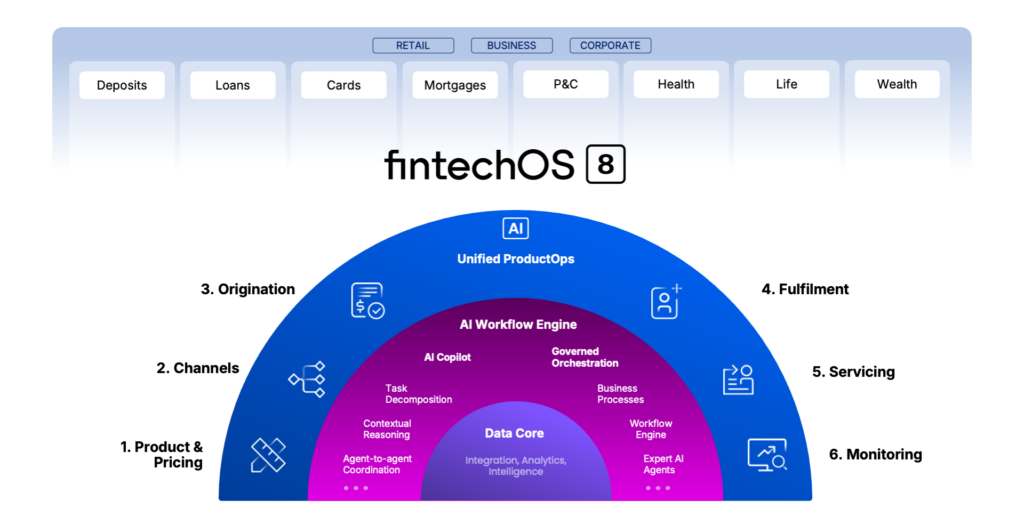
At FintechOS, this is exactly why we deliver a Unified Product Pricing and Origination solution – bringing product definition, pricing, eligibility, workflow orchestration, and decisioning into one governed operational flow across products and channels. The architectural implication is simple but powerful: product logic moves above the core into a reusable operational layer, reducing duplication across multiple origination stacks and creating the consistent “control plane” required for AI to operate safely and repeatedly.
Critically, this is not an abstract promise; it shows up in the metrics that matter to banking executives. Unified Origination is associated with launching new propositions in weeks, higher conversion driven by consistent and personalized decisioning, and a measurable lift in cross-sell at origination – all compounding into incremental revenue over time as product mix improves and high-intent customer workflows convert more consistently. We would be happy to share results from specific benchmarks and deployments.
FintechOS has delivered over 50 origination programs across a broad base of financial institutions over the years. With FintechOS 8, available starting April 2025, we will scale these capabilities with governed AI. This is AI that is deployable inside origination and pricing: domain-aware copilots and specialized agents, deterministic and agentic workflows with governance, and auditability built directly into product operations – so banks can enhance decisioning, pricing, and operational throughput without creating parallel, ungoverned decision paths.
As the Digital Scorecard increasingly reflects AI and LLM adoption alongside digital proposition and experience, the banks that rise fastest will be those that treat AI as an operating model decision: unify the operational substrate, embed intelligence where decisions happen, and measure outcomes in conversion, product mix, time-to-launch, and cost-to-serve. Origination is simply the most immediate place to start – and proof that there is a different way to originate and drive growth without changing the core.
For a broader view of how Romanian banks are progressing across digital onboarding, lending, mobile experiences, AI adoption, and customer journeys, download the Future Banking Digital Scorecard 2026 report.